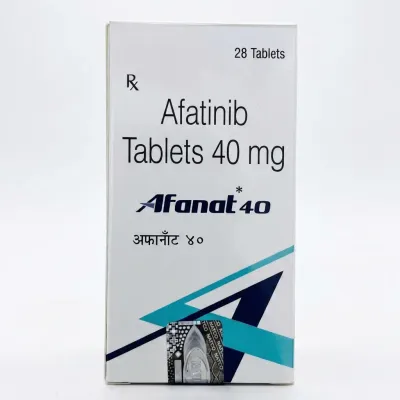
Afatinib – Targeted Therapy
Known as original brand(s)
Giotrif
Afatinib is a potent, highly selective, and irreversible blocker of the ErbB receptor family. As a targeted anti-tumor agent, it represents a significant advancement in the management of specific types of lung cancer.
The mechanism of action involves forming a strong covalent bond with the active sites of EGFR (ErbB1), HER2 (ErbB2), and ErbB4 receptors. Unlike first-generation reversible inhibitors, afatinib irreversibly shuts down signaling from these receptors, which are responsible for the growth, survival, and spread of tumor cells. This enables effective suppression of cancer cell proliferation, even in cases where tumors have developed resistance to other therapies. The drug is particularly effective in patients harboring specific mutations in the EGFR gene.
Administered orally in tablet form, afatinib allows for sustained therapy aimed at controlling tumor progression.

Indications
Afatinib is indicated for the treatment of adult patients in the following clinical scenarios:
- EGFR-mutated NSCLC: as a first-line treatment for metastatic non-small cell lung cancer (NSCLC) with non-resistant EGFR mutations.
- Squamous NSCLC: treatment of metastatic squamous NSCLC progressing on or after platinum-based chemotherapy.
Dosage and administration
Afatinib dosage is determined individually and may be adjusted by a physician based on patient tolerance.
- Standard Dose: 40 mg once daily.
- Maximum Dose: may be increased to 50 mg daily in specific clinical circumstances.
- Administration Rules: must be taken on an empty stomach (at least 1 hour before or 3 hours after a meal).
- Dose Modification: if severe adverse reactions occur, the dose may be temporarily reduced (to 30 mg or 20 mg) until symptoms stabilize.