
Enasidenib – First-in-Class Mutant IDH2 Inhibitor Therapy

Enasidenib is an oral, first-in-class, highly selective small-molecule targeted inhibitor of the mutant isocitrate dehydrogenase 2 (IDH2) enzyme engineered for precision oncology therapy. The drug is developed for the targeted management of specific aggressive subtypes of acute myeloid leukemia (AML). The mechanism of action of enasidenib fundamentally differs from standard cytotoxic chemotherapy: it focuses on restoring normal cellular differentiation. In tumor cells harboring somatic IDH2 mutations (most commonly at codons R140 and R172), the enzyme gains an abnormal neomorphic activity, catalyzing the reduction of alpha-ketoglutarate to the oncometabolite 2-hydroxyglutarate (2-HG). Accumulation of 2-HG blocks alpha-ketoglutarate-dependent dioxygenases, inducing global hypermethylation of DNA and histones, which halts myeloid progenitor cell differentiation. Enasidenib allosterically binds to the mutant IDH2 dimer, reducing intracellular 2-HG levels by over 90%. This drives epigenetic remodeling, releases the differentiation block, and forces leukemic blasts to mature into functional, non-malignant neutrophils.

The clinical uniqueness of enasidenib lies in its capacity to achieve durable hematologic responses and remissions in patients with relapsed or refractory AML through the phenomenon of non-cytotoxic tumor clone differentiation. The drug displays high oral bioavailability, reaching steady-state plasma concentrations within approximately 21 days of continuous daily dosing. Enasidenib is characterized by an exceptionally prolonged elimination half-life (around 137 hours), is extensively metabolized in the liver via multiple cytochrome pathways (principally CYP2C19, CYP3A4, and CYP2D6) alongside direct glucuronidation, and is excreted predominantly in the feces.

The drug is administered orally. Prior to initiating treatment, documentation of the somatic IDH2 mutation status (R140 or R172) using a validated molecular-genetic diagnostic PCR or NGS assay is mandatory. Strict clinical monitoring of complete blood counts and blood biochemistry parameters is required throughout therapy.

Wikipedia page
Enasidenib

Indications

Enasidenib is indicated as a precision targeted monotherapy for adult patients with the following malignant hematological disease:

  • Relapsed or Refractory Acute Myeloid Leukemia (AML): treatment of adult patients with relapsed or refractory acute myeloid leukemia harboring a confirmed somatic mutation in the IDH2 gene (specifically at codons R140 or R172).

Dosage and administration

The dosing regimen of enasidenib is continuous and structured for long-term daily administration, with parameters for treatment interruption or step-down modification based on clinical toxicities.

  • Standard Dose: the recommended initial dose is 100 mg taken orally once daily.
  • Schedule and Duration: the drug is taken daily within conventional 28-day cycles. Treatment should be maintained for a minimum of 6 months to allow adequate time for a clinical response assessment, unless rapid disease progression or unacceptable systemic toxicity occurs.
  • Administration Method: tablets must be swallowed whole at approximately the same time each day, with or without food. Tablets must not be broken, crushed, or chewed, and should be administered with a full glass of water.
  • Missed Dose: if a dose is missed or if vomiting occurs shortly after administration, an additional capsule must not be taken that day. The patient should skip the missed dose and resume their regular schedule the following day at the planned time.
  • Dose Modification: if Differentiation Syndrome, asymptomatic total bilirubin elevations greater than 3 times the upper limit of normal, or QTc interval prolongation occurs, therapy must be withheld until toxicity resolves to Grade 1-2, followed by a dose reduction to 50 mg once daily.

The use of enasidenib is restricted by systemic metabolic risks and embryofetal toxicities, and is contraindicated in the following conditions:

  • Hypersensitivity: documented history of allergic reactions, anaphylaxis, or individual hypersensitivity to enasidenib or any inactive formulation excipients.
  • Pregnancy and Lactation: the drug carries a high risk of direct teratogenicity and embryofetal toxicity. Use during pregnancy is strictly contraindicated. Female patients of reproductive potential and male patients with female partners must use highly effective contraception during therapy and for 2 months post-treatment. Breastfeeding is prohibited during treatment and for 2 months following the final dose.
  • Severe Hepatic Impairment: pre-existing severe hepatic insufficiency (Child-Pugh Class C) due to high accumulation risks given the complex multi-pathway hepatic clearance profile of the drug.

The side effects of enasidenib are primarily driven by the systemic differentiation of leukemic cells and specific off-target pathway metabolic clearance mechanisms:

  • Differentiation Syndrome: a life-threatening condition driven by the rapid maturation and proliferation of myeloid cells, presenting with fever, dyspnea, hypoxemia, pulmonary infiltrates, pleural effusion, rapid weight gain, and peripheral edema, requiring immediate high-dose intravenous corticosteroid intervention (dexamethasone).
  • Hyperbilirubinemia: a very common laboratory finding that represents off-target inhibition of the UGT1A1 enzyme by enasidenib, blocking indirect bilirubin conjugation rather than reflecting intrinsic hepatic injury; does not require treatment interruption if transaminases remain stable.
  • Gastrointestinal Tract: pronounced decreased appetite, nausea, vomiting, diarrhea or persistent constipation, and taste alterations (dysgeusia).
  • Electrolyte Disturbances: severe hypokalemia (decreased blood potassium levels) and hypophosphatemia, necessitating routine laboratory monitoring and electrolyte replacement.
  • General Symptoms: severe fatigue, generalized musculoskeletal pain, peripheral edema, exertional dyspnea, and skin rash.

Frequently Asked Questions

Enasidenib is an oral targeted therapy that functions as a small-molecule selective inhibitor of the mutant isocitrate dehydrogenase-2 (IDH2) enzyme. In the presence of this genetic mutation within bone marrow cells, an abnormal oncometabolite (2-hydroxyglutarate) accumulates and blocks normal blood cell development. Enasidenib decreases levels of this metabolite, thereby restoring the natural process of cellular differentiation (maturation) of immature blast cells into mature, functional blood cells.
Enasidenib is indicated for the treatment of adult patients with relapsed or refractory acute myeloid leukemia (AML). The use of this medication is strictly restricted to patients with a confirmed $IDH2$ mutation (including R140 and R172 codon variants). Verifying biomarker status with a validated companion diagnostic genetic test is mandatory prior to treatment initiation.
Enasidenib is administered orally once daily (standard dose is 100 mg) at approximately the same time each day, with or without food. The tablets must be swallowed whole with a glass of water. If vomiting occurs after taking a dose, an additional or replacement tablet must not be administered that day; the patient should simply wait and take the next scheduled dose the following day at the regular time.
Differentiation syndrome is a distinct and potentially fatal, life-threatening complication caused by the rapid maturation and proliferation of myeloid cells induced by the drug. Symptoms include fever, cough, acute dyspnea (shortness of breath), pulmonary infiltrates, rapid weight gain (exceeding 4 to 5 kg), peripheral edema, and hypotension. If any of these signs manifest, immediate medical attention is critical, as it requires the urgent initiation of high-dose systemic corticosteroids (e.g., dexamethasone).
Enasidenib frequently induces elevated concentrations of total serum bilirubin (hyperbilirubinemia), which may manifest clinically as jaundice of the skin and sclera. Unlike with classical hepatotoxity, this phenomenon is primarily driven by the drug's intrinsic inhibition of the UGT1A1 enzyme responsible for bilirubin metabolism, and does not necessarily reflect direct hepatocellular injury. Nonetheless, close laboratory surveillance via liver function tests (specifically monitoring ALT, AST, and fractions of bilirubin) is required every two weeks during the first two months of therapy.

List of medicines by active substance

-7%
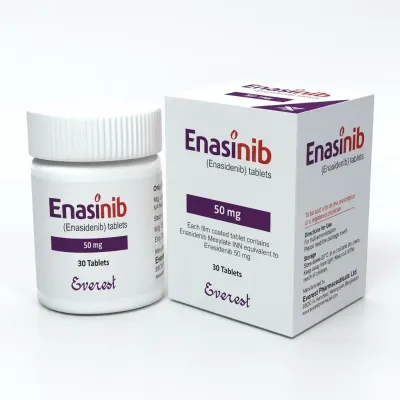
Enasinib
View
Everest
50 mg 30 tablets
62580₴ 67050₴
✅ All products loaded (1)
Unifarm

Unifarm app

Safari → Share → Add to Home Screen Firefox: menu ⋮ → Install or Add to Home screen. If missing, open the site in Chrome. Chrome: menu ⋮ → Install app or Add to Home screen.

Contact us

Choose a convenient way to contact

We work daily from 9:00 to 20:00