
Gilteritinib – Potent FLT3/AXL Inhibitor Targeted Therapy

Gilteritinib is an oral, highly selective, potent second-generation small-molecule tyrosine kinase inhibitor engineered for the precision treatment of specific aggressive subtypes of acute myeloid leukemia (AML). The primary target of the drug is the receptor tyrosine kinase FLT3 (Fms-like tyrosine kinase 3), which plays a pivotal role in the proliferation, survival, and differentiation of hematopoietic progenitor cells. Gilteritinib is unique in that it demonstrates combined activity against the two major types of FLT3 mutations: internal tandem duplications (FLT3-ITD), which correlate with an extremely high risk of relapse, and tyrosine kinase domain (FLT3-TKD) mutations, which frequently drive resistance to first-generation kinase inhibitors. Its mechanism of action involves competitive blockade of the ATP-binding site of the receptor, halting its autophosphorylation, disrupting downstream intracellular signaling cascades (including the MAPK/ERK, PI3K/AKT/mTOR, and STAT5 pathways), and inducing apoptosis in leukemic blast cells. Additionally, the drug inhibits AXL kinase, which is co-expressed on AML cells and participates in tumor cell survival mechanisms.

The clinical uniqueness of gilteritinib lies in its ability to overcome primary and secondary resistance within bone marrow tumor cells, enabling achieve complete remission in patients with relapsed or refractory disease without requiring aggressive cytotoxic chemotherapy regimens. The drug exhibits high bioavailability upon oral administration, reaching steady-state plasma concentrations within approximately 7 to 15 days of continuous dosing. Gilteritinib is characterized by a prolonged elimination half-life (around 113 hours), is primarily metabolized in the liver by the cytochrome CYP3A4 isoenzyme, and is excreted predominantly in the feces as unchanged drug.

The drug is administered orally. Prior to initiating therapy, verification of the FLT3 mutation status (ITD or TKD) using a validated molecular-genetic diagnostic assay is mandatory. Continuous clinical monitoring of blood counts, biochemistry parameters, and the QTc interval is required throughout treatment.

Wikipedia page
Gilteritinib

Indications

Gilteritinib is indicated as a precision targeted monotherapy for adult patients with the following malignant hematological disease:

  • Relapsed or Refractory Acute Myeloid Leukemia (AML): treatment of adult patients with relapsed or refractory acute myeloid leukemia harboring a confirmed FLT3 mutation (either ITD or TKD).

Dosage and administration

The dosing regimen of gilteritinib is continuous and structured for long-term daily administration, with provisions for step-by-step dose modification based on clinical response and patient tolerability.

  • Standard Dose: the recommended initial dose is 120 mg (three 40 mg tablets) taken orally once daily.
  • Schedule and Duration: the drug is taken daily within conventional 28-day cycles. Therapy should be continued as long as the patient derives clinical benefit or until unacceptable systemic toxicity occurs. Treatment response assessment is typically performed after completion of at least one cycle.
  • Administration Method: tablets must be swallowed whole at approximately the same time each day, with or without food. Tablets must not be broken, crushed, or chewed, and should be administered with a sufficient volume of water.
  • Missed Dose: if a dose is missed, it should be taken as soon as possible on the same day, provided the next scheduled dose is more than 12 hours away. A double dose must not be taken on the following day to compensate.
  • Dose Modification: if a therapeutic response is not achieved after 4 weeks of treatment, the dose may be escalated to 200 mg once daily. If the QTc interval extends beyond 500 ms or Differentiation Syndrome develops, therapy must be withheld until stabilization, with a subsequent dose reduction to 80 mg.
The use of gilteritinib is restricted by risks of severe cardiotoxicity, teratogenicity, and metabolic incompatibility, and is contraindicated in the following conditions:

  • Hypersensitivity: documented history of allergic reactions, anaphylaxis, or individual hypersensitivity to gilteritinib or any inactive tablet excipients.
  • Severe Cardiological Pathology: congenital or acquired long QT syndrome, a baseline QTc interval of greater than 450 ms, or severe cardiac arrhythmias.
  • Pregnancy and Lactation: the drug exerts direct embryotoxic effects and can cause fetal death. Use during pregnancy is contraindicated. Women of childbearing potential and male patients must utilize effective contraception during therapy and for 6 months post-treatment. Breastfeeding is prohibited during treatment and for 2 months following the final dose.
  • Drug Interactions: concomitant administration with strong CYP3A4 inducers (such as rifampin or St. John's wort) is contraindicated, as they critically decrease systemic exposure to gilteritinib.

The side effects of gilteritinib are driven by its specific mechanism of targeted FLT3/AXL kinase inhibition and systemic toxic liabilities:

  • Differentiation Syndrome: a life-threatening condition characterized by fever, dyspnea, pleural or pericardial effusion, rapid weight gain, and peripheral edema, requiring immediate high-dose corticosteroid intervention.
  • Posterior Reversible Encephalopathy Syndrome (PRES): a rare neurological disorder manifesting with seizures, altered mental status, blindness, and severe headache, requiring immediate permanent discontinuation of the drug.
  • Cardiovascular System: dose-dependent prolongation of the EKG QTc interval, sinus tachycardia, peripheral edema, hypotension, or hypertension.
  • Laboratory Parameters: pronounced elevations in liver transaminases (AST, ALT), blood creatine phosphokinase (CPK), and alkaline phosphatase.
  • Hematologic Toxicities: thrombocytopenia, lymphopenia, neutropenia, and anemia, which may worsen during the initial phases of cytoreduction.
  • Gastrointestinal Tract and General Symptoms: diarrhea, nausea, constipation, stomatitis, severe fatigue, generalized musculoskeletal pain, and skin rash.

Frequently Asked Questions

Gilteritinib is an oral targeted therapy that acts as a highly selective and potent inhibitor of the FLT3 (Fms-like tyrosine kinase 3) receptor. Mutations in the FLT3 gene occur in approximately one-third of patients with acute myeloid leukemia (AML) and drive rapid, aggressive malignant cell proliferation. Gilteritinib effectively blocks downstream signaling pathways in both FLT3-ITD and FLT3-TKD mutations, thereby arresting cellular division and inducing apoptosis in leukemic cells.
Gilteritinib is indicated for the treatment of adult patients with relapsed or refractory acute myeloid leukemia (AML) harboring a confirmed FLT3 mutation. Prior to initiating therapy, it is mandatory to verify the presence of the FLT3 mutation utilizing a validated diagnostic genetic test.
Gilteritinib is taken orally once daily (standard dose is 120 mg) at approximately the same time each day, with or without food. The tablets must be swallowed whole and should not be crushed or chewed. If a dose is missed and less than 12 hours have passed, it should be taken immediately. If the next scheduled dose is less than 12 hours away, the missed dose must be skipped, and the regular dosing schedule resumed the following day.
Differentiation syndrome is a potentially fatal, life-threatening condition driven by the rapid maturation and proliferation of myeloid cells induced by the drug. Key symptoms include fever, progressive dyspnea (shortness of breath), cough, pleural or pericardial effusions, rapid weight gain, peripheral edema, and hypotension. If any of these symptoms manifest, the patient must seek emergency medical intervention, as the immediate initiation of high-dose systemic corticosteroids (e.g., dexamethasone) is critical.
Gilteritinib can prolong the QT interval on an electrocardiogram (ECG), which increases the risk of severe ventricular arrhythmias. ECG assessments must be performed prior to starting therapy, on days 8 and 15 of the first cycle, and monthly thereafter. The drug is also associated with posterior reversible encephalopathy syndrome (PRES), presenting with seizures or severe headache, and pancreatitis. Your healthcare team will routinely monitor blood chemistry panels, specifically focusing on fluid electrolyte levels (potassium, magnesium) and pancreatic enzymes (lipase, amylase).

List of medicines by active substance

-7%
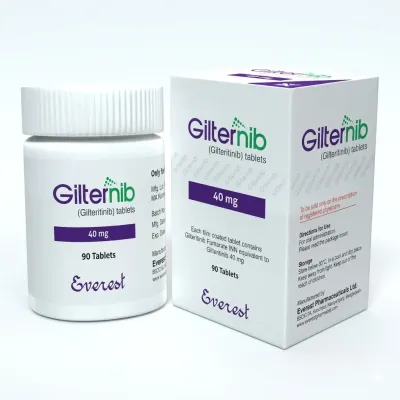
Gilternib 40 mg Everest
View
Everest
40 mg
55465₴ 59902₴
✅ All products loaded (1)

Contact us

Choose a convenient way to contact

We work daily from 9:00 to 20:00