
Capivasertib – Potent Selective Akt Kinase Inhibitor Targeted Therapy

Capivasertib is an oral, first-in-class, highly selective small-molecule targeted inhibitor of all three isoforms of the serine-threonine protein kinase Akt (Akt1, Akt2, and Akt3). The drug is engineered for the precision oncology treatment of advanced hormone-receptor positive malignancies. The mechanism of action of capivasertib involves highly specific binding to the ATP-binding domain of the Akt kinase, preventing the phosphorylation of its numerous downstream substrates. The PI3K/Akt/mTOR pathway is a central regulatory cascade controlling cell survival, proliferation, and metabolism. In tumor cells, this pathway is frequently constitutively hyperactivated due to somatic mutations in PIK3CA or AKT1 genes, or through the loss-of-function alterations in the PTEN tumor suppressor. Akt blockade by capivasertib effectively disrupts oncogenic signaling, restores apoptotic mechanisms, and suppresses the growth of tumor clones exhibiting resistance to standard endocrine therapies.

The clinical uniqueness of capivasertib lies in its ability to overcome acquired endocrine resistance in patients with HR-positive, HER2-negative breast cancer harboring specific alterations within the PI3K/Akt/PTEN pathway, particularly when combined with selective estrogen receptor degraders (such as fulvestrant). The drug displays high oral bioavailability. Steady-state plasma concentrations are achieved within the first week of administration utilizing an intermittent dosing schedule designed to minimize systemic liabilities. Capivasertib is primarily metabolized in the liver via the CYP3A4 isoenzyme and is excreted as metabolites and unchanged drug predominantly through the intestines in the feces and partially via the kidneys in the urine.

The drug is administered orally. Prior to initiating targeted treatment, documentation of genetic alterations in PIK3CA, AKT1 genes, or PTEN deficiency using a validated molecular-genetic NGS or PCR assay is mandatory. Strict clinical monitoring of plasma glucose levels and cutaneous integrity is required throughout therapy.

Wikipedia page
Capivasertib

Indications

Capivasertib is indicated as a precision targeted combination therapy for adult patients with the following malignant oncological condition:

  • Hormone-Resistant Breast Cancer: treatment of adult patients with locally advanced or metastatic hormone receptor-positive (HR+), human epidermal growth factor receptor 2-negative (HER2-) breast cancer harboring one or more genetic alterations (PIK3CA mutations, AKT1 mutations, or PTEN alterations), following progression on or after endocrine-based regimens, in combination with fulvestrant.

Dosage and administration

The dosing regimen of capivasertib is intermittent, specifically structured to reduce the severity of systemic metabolic and gastrointestinal toxic liabilities.

  • Standard Dose: the recommended therapeutic dose is 400 mg (two 200 mg tablets) taken orally twice daily (morning and evening, approximately 12 hours apart).
  • Schedule and Duration: the drug is taken on an intermittent schedule: 4 consecutive days of treatment followed by 3 days of mandatory rest each week. Treatment should be maintained until disease progression or unacceptable systemic toxicity occurs.
  • Administration Method: tablets must be swallowed whole with a glass of water and can be taken with or without food. Tablets must not be broken, crushed, or chewed during handling.
  • Missed Dose: if a scheduled dose is missed by more than 4 hours, it should be skipped. The patient must take the next dose at the regular scheduled time. A double dose must never be taken.
  • Dose Modification for Toxicity: if severe skin rash, uncontrolled diarrhea, or severe hyperglycemia develops, therapy must be temporarily withheld. Upon resolution, treatment is resumed with step-down reductions (first step down to 320 mg twice daily, and second step down to 200 mg twice daily following the same 4/3 schedule).
The use of capivasertib is restricted by metabolic dysregulation risks, severe cutaneous complications, and embryofetal liabilities, and is contraindicated in the following conditions:

  • Hypersensitivity: documented history of anaphylaxis, angioedema, or individual hypersensitivity to capivasertib or any inactive formulation excipients.
  • History of Severe Cutaneous Reactions: a history of severe drug-induced dermatoses, such as Stevens-Johnson syndrome or toxic epidermal necrolysis, as Akt inhibitors can trigger life-threatening exfoliative rash.
  • Pregnancy and Lactation: the drug carries a high risk of direct embryofetal toxicity. Use during pregnancy is strictly contraindicated. Female patients of reproductive potential and male patients with female partners must utilize highly effective contraception during therapy and for 1 month post-treatment. Breastfeeding is prohibited during treatment and for 1 month following the final dose.
  • Drug Interactions: concomitant administration with strong CYP3A4 inhibitors or inducers is contraindicated, as they critically alter capivasertib therapeutic plasma exposure.

The side effects of capivasertib are driven by the systemic inhibition of physiological Akt metabolic and proliferative path mechanisms in healthy tissues:

  • Gastrointestinal Toxicities: very frequently presents as severe diarrhea that can lead to significant dehydration, alongside nausea, vomiting, stomatitis (oral mucosal inflammation), and acute abdominal pain.
  • Metabolic Disorders (Hyperglycemia): Akt is a central mediator of insulin signaling; its blockade induces acute insulin resistance, leading to marked plasma glucose elevations, new-onset or worsening diabetes mellitus requiring oral hypoglycemic therapy.
  • Dermatological Toxicities: maculopapular rash, pruritus, erythema, severe xerosis (dry skin), and dermatitis, occasionally progressing to severe exfoliative disorders.
  • Hematologic Parameters: moderate myelosuppression manifesting as lymphopenia, anemia, leukopenia, and thrombocytopenia.
  • General Symptoms: profound fatigue, asthenia, decreased appetite, fluid retention resulting in peripheral edema, and mild elevations in liver transaminases.

Frequently Asked Questions

Capivasertib is an oral targeted therapy that functions as a potent and selective inhibitor of all three isoforms of the serine/threonine kinase AKT (AKT1, AKT2, AKT3). The AKT kinase plays a central role in the PI3K/AKT/mTOR signaling pathway, which regulates cell survival, growth, and proliferation. In many cancers, this pathway becomes hyperactivated due to genetic alterations, driving resistance to standard endocrine therapies. Capivasertib blocks AKT activity, thereby restoring treatment sensitivity and halting tumor progression.
Capivasertib is indicated in combination with fulvestrant for the treatment of adult patients with hormone receptor-positive (HR+), HER2-negative locally advanced or metastatic breast cancer. It is prescribed following progression on or after endocrine-based regimens, specifically for tumors that harbor one or more susceptibility alterations in the PIK3CA, AKT1, or PTEN genes. Verifying these biomarkers via a validated molecular assay is mandatory before starting treatment.
Capivasertib is administered in an intermittent weekly cyclic regimen: tablets are taken twice daily (morning and evening, approximately 12 hours apart) for 4 consecutive days, followed by a 3-day break without the drug. This schedule is repeated every week. The tablets can be taken with or without food and must be swallowed whole. This specific pulse design (4 days on / 3 days off) is essential to minimize cumulative toxicities and allow healthy tissues to recover while maintaining potent anti-tumor activity.
Because the AKT kinase is fundamentally involved in mediating insulin signaling, inhibition of this pathway frequently results in hyperglycemia (elevated blood glucose levels). Patients must undergo regular monitoring of fasting plasma glucose and glycated hemoglobin (HbA1c). Enhanced surveillance is critical for patients with a pre-existing history of diabetes mellitus. If severe glucose elevations occur, physicians will initiate or optimize anti-diabetic therapies, or implement capivasertib dose reductions if required.
Diarrhea is highly prevalent and represents a major dose-limiting adverse effect of capivasertib. Patients should have anti-diarrheal medications (such as loperamide) readily available and initiate treatment at the very first episode of unformed stools, alongside aggressive oral rehydration. Dermatological toxicities, commonly presenting as maculopapular rash and severe pruritus, are also frequent. Patients must report any widespread, painful, or exfoliating skin eruptions immediately for prompt intervention with topical steroids or dose alterations.

List of medicines by active substance

-9%
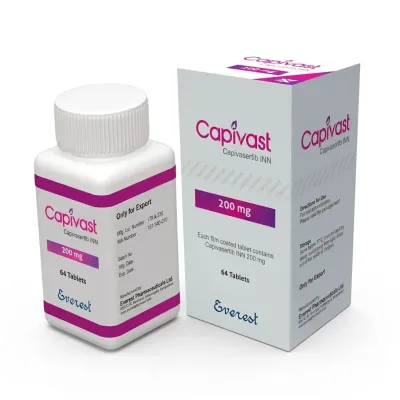
Capivast 200 mg Everest
View
Everest
200 mg 64 tablets
57606₴ 63006₴
✅ All products loaded (1)

Contact us

Choose a convenient way to contact

We work daily from 9:00 to 20:00