
Ceritinib – Potent Second-Generation ALK Inhibitor Targeted Therapy

Ceritinib is an oral, highly selective, and potent second-generation small-molecule anaplastic lymphoma kinase (ALK) tyrosine kinase inhibitor, engineered for the systemic targeted therapy of solid tumors. The mechanism of action of ceritinib involves blocking the autophosphorylation of the ALK kinase domain, resulting in the complete suppression of downstream signaling pathways such as STAT3, PI3K/AKT/mTOR, and MAPK/ERK. This effectively disrupts proliferation and induces apoptosis in tumor cells expressing ALK fusion proteins or mutant forms of the kinase. The core pharmacological feature of ceritinib is its ability to overcome resistance to first-generation ALK inhibitors (specifically crizotinib) mediated by secondary mutations within the kinase domain. Additionally, ceritinib inhibits the insulin-like growth factor 1 receptor (IGF-1R), insulin receptor (InsR), and ROS1 proto-oncogene with minimal inhibition of off-target kinases.

The clinical uniqueness of ceritinib lies in its excellent ability to penetrate the blood-brain barrier and achieve high therapeutic concentrations within central nervous system tissues, enabling deep and durable intracranial responses in patients with metastatic brain lesions. The drug demonstrates high bioavailability, though its absorption is significantly affected by food intake. Peak plasma exposure is achieved within a median of 4 to 6 hours post-dose. Ceritinib is extensively bound to human plasma proteins (approximately 97%) and is primarily metabolized in the liver via the CYP3A4 isoenzyme through oxidative and dealkylation pathways. The mean elimination half-life ranges from approximately 31 to 41 hours, providing stable systemic exposure. Systemic clearance occurs predominantly through the intestines in the feces, with a minor fraction cleared via the kidneys in the urine.

The drug is administered orally. Initiating therapy requires mandatory prior molecular-genetic confirmation of the presence of an ALK gene rearrangement. Ongoing treatment necessitates regular monitoring of hepatic function, blood glucose levels, serum electrolytes, electrocardiograms, and serum amylase/lipase levels.

Wikipedia page
Ceritinib

Indications

Ceritinib is indicated as a systemic targeted monotherapy for adult patients presenting with the following malignant neoplasm:

  • Non-Small Cell Lung Cancer (NSCLC): treatment of adult patients with locally advanced or metastatic non-small cell lung cancer harboring anaplastic lymphoma kinase rearrangements (ALK-positive NSCLC), either as first-line therapy or following disease progression on prior crizotinib therapy.

Dosage and administration

The dosing regimen of ceritinib requires strict adherence to co-administration guidelines with food and individual dose modifications based on treatment-related toxicities.

  • Standard Therapeutic Dose: the recommended therapeutic dose is 450 mg taken orally once daily. The drug must be taken daily, at approximately the same time each day.
  • Food Co-administration: the drug must be taken with food (ranging from a light snack to a full meal). It has been clinically established that administering 450 mg with food provides equivalent systemic exposure while significantly improving gastrointestinal tolerability compared to the former regimen of 750 mg taken under fasted conditions.
  • Administration Method: capsules or tablets are taken orally, must be swallowed whole, and washed down with a glass of water. Opening, breaking, crushing, or chewing the medicinal product during handling is strictly prohibited.
  • Missed Dose: if a scheduled dose is delayed by less than 12 hours, the patient must take the missed dose immediately and resume the regular schedule. If the delay exceeds 12 hours, that dose must be skipped entirely, and the patient returns to the planned routine. Taking a double dose on the following day is strictly prohibited. If vomiting occurs after taking a dose, a repeat capsule must not be administered on that day.
  • Dose Modification for Toxicity: if severe adverse reactions develop (such as prominent hepatotoxicity, severe diarrhea, hyperglycemia, or QTc interval prolongation), therapy must be temporarily withheld. Upon clinical resolution of symptoms, treatment is resumed with step-down dose reductions of 150 mg: first to 300 mg once daily, then to 150 mg once daily. If a patient cannot tolerate 150 mg once daily, the drug must be permanently discontinued.

The use of ceritinib is strictly restricted by risks of severe organ toxicity, cardiac electrophysiological disturbances, and embryofetal harm, and is contraindicated in the following conditions:

  • Hypersensitivity: documented history of anaphylaxis, angioedema, or individual hypersensitivity to ceritinib or any inactive formulation excipients inside the product.
  • Severe Hepatic Impairment: baseline severe hepatic impairment (Child-Pugh Class C) due to the elevated risk of drug accumulation and hepatic decompensation.
  • QT Interval Prolongation: baseline clinically significant QTc prolongation (greater than 500 ms) or concurrent use of medicinal products known to significantly prolong the QT interval, due to the high risk of inducing fatal cardiac arrhythmias.
  • Pregnancy and Lactation: based on its mechanism of action, the drug poses a high risk to the fetus, demonstrating distinct embryotoxic and teratogenic potential. Use in pregnant women is contraindicated. Women of childbearing potential must utilize highly effective contraception methods during therapy and for 3 months following the final dose. Breastfeeding is prohibited during treatment and for 2 weeks after the last dose.
  • Pediatric Population: the safety, tolerability, and clinical efficacy profiles of ceritinib in children and adolescents under the age of 18 have not been established; use within this age cohort is contraindicated.

The side effects of ceritinib are predominantly driven by its class-specific toxic impacts on the gastrointestinal epithelium, hepatic parenchyma, and metabolic homeostatic pathways:

  • Gastrointestinal Toxicity: very frequently presents as diarrhea, nausea, vomiting, abdominal pain, and decreased appetite (these symptoms manifest in the majority of patients but are drastically mitigated when taken with food).
  • Hepatotoxicity: prominent transient or sustained elevations in liver transaminases (ALT, AST) and gamma-glutamyltransferase, alongside increases in alkaline phosphatase and total bilirubin levels.
  • Metabolic Disorders: development of marked hyperglycemia (elevated blood glucose levels) requiring initiation or dose optimization of anti-diabetic therapies, alongside hypophosphatemia.
  • Pancreatic Impairment: asymptomatic or clinically manifest elevation of plasma lipase and amylase levels; in rare instances, development of acute pancreatitis.
  • Cardiovascular System: dose-dependent QT interval prolongation on electrocardiograms, sinus bradycardia, and peripheral edema.
  • Respiratory System (Pulmonotoxicity): development of interstitial lung disease (ILD) or severe pneumonitis, presenting with cough and dyspnea, which mandates immediate and permanent treatment discontinuation if confirmed.

Frequently Asked Questions

Ceritinib is an oral, highly selective, second-generation tyrosine kinase inhibitor targeting anaplastic lymphoma kinase (ALK). It is designed to inhibit the abnormal ALK fusion protein that drives uncontrolled malignant cell proliferation. The primary advantage of ceritinib is its significantly greater potency compared to first-generation inhibitors (such as crizotinib), allowing it to overcome most acquired resistance mutations. Additionally, ceritinib demonstrates excellent blood-brain barrier penetration, making it highly effective against central nervous system metastases.
Ceritinib is indicated for the treatment of adult patients with advanced or metastatic non-small cell lung cancer (NSCLC). It can be prescribed as a first-line targeted therapy or following disease progression on crizotinib. Administration is strictly conditional on a confirmed positive status for the ALK biomarker (ALK rearrangement/translocation), verified via a validated molecular-genetic assay prior to initiating treatment.
The standard recommended dosage of ceritinib is 450 mg (three 150 mg tablets) taken orally once daily. The medication must be administered strictly with food (during or immediately after a full meal) and swallowed whole with water. Co-administration with a meal is a critical clinical requirement, as food significantly enhances gastrointestinal tolerability and markedly reduces the severity of GI toxicities that were highly prevalent under historical fasting protocols.
Gastrointestinal toxicities, including diarrhea, nausea, vomiting, and abdominal pain, occur in a high percentage of patients. At the first onset of loose stools, anti-diarrheal therapy (such as loperamide) should be initiated alongside oral rehydration. A more critical risk is the development of acute pancreatitis or asymptomatic elevations in pancreatic enzymes (lipase and amylase). These enzymes must be monitored routinely via blood tests; any severe, acute epigastric pain radiating to the back mandates immediate emergency screening.
Ceritinib can induce significant hepatotoxicity, necessitating liver function tests (ALT, AST, and bilirubin) every two weeks during the initiation phase. It also carries a risk of life-threatening interstitial lung disease (pneumonitis); patients must withhold the drug immediately if new respiratory symptoms like dyspnea or cough occur. Cardiologically, it can cause severe bradycardia (slow heart rate) and QTc interval prolongation on an ECG. Additionally, hyperglycemia is a frequent metabolic complication, requiring regular blood glucose and cardiac rhythm monitoring.

List of medicines by active substance

-11%
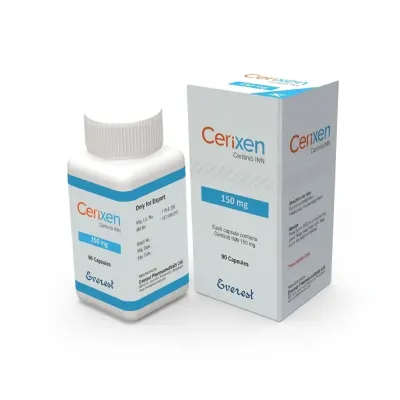
Cerixen 150 mg Everest
View
Everest
150 mg 90 capsules
53933₴ 60674₴
✅ All products loaded (1)

Contact us

Choose a convenient way to contact

We work daily from 9:00 to 20:00