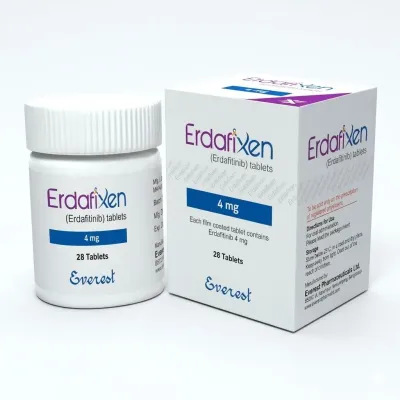
Erdafitinib – Pan-FGFR Kinase Inhibitor Targeted Therapy
Known as original brand(s)
Balversa
Erdafitinib is an oral, first-in-class, highly selective small-molecule targeted inhibitor of fibroblast growth factor receptors (FGFR) engineered for precision oncology therapy. The drug is developed to target specific genomic alterations within the FGFR gene family. The mechanism of action of erdafitinib involves reversible binding and inhibition of the tyrosine kinase domains of FGFR1, FGFR2, FGFR3, and FGFR4. Blockade of these receptors prevents their autophosphorylation and effectively downstream intracellular signaling cascades, including the mitogen-activated protein kinase (MAPK) and phosphoinositide 3-kinase (PI3K/AKT) pathways. This delivers potent suppression of cell proliferation, migration, angiogenesis, and induces apoptosis in tumor cells demonstrating constitutive FGFR activation driven by somatic mutations or gene fusions.
The clinical uniqueness of erdafitinib lies in its capacity to achieve meaningful and sustained objective responses in patients with advanced or metastatic urothelial carcinoma that has progressed on or after standard platinum-based chemotherapy and immune checkpoint inhibitors (PD-1/PD-L1), provided they harbor specific FGFR3 mutations or FGFR2/3 fusions. The drug displays high oral bioavailability, reaching steady-state plasma concentrations within approximately 2 weeks of daily administration. Erdafitinib is extensively metabolized in the liver, primarily via the CYP2C9 and CYP3A4 isoenzymes, and is excreted predominantly in the feces as metabolites and unchanged drug.
The drug is administered orally. Prior to initiating treatment, documentation of FGFR gene mutations or fusions using a validated next-generation sequencing (NGS) or PCR assay is mandatory. Strict ophthalmological surveillance and regular monitoring of serum phosphate levels are required throughout therapy.

Indications
Erdafitinib is indicated as a precision targeted monotherapy for adult patients with the following malignant oncological condition:
- Metastatic Urothelial Carcinoma: treatment of adult patients with locally advanced or metastatic urothelial carcinoma (including cancer of the bladder, ureter, and renal pelvis) that has progressed during or following at least one line of prior systemic chemotherapy, with confirmed FGFR3 genetic mutations or fusions, or FGFR2 fusions.
Dosage and administration
The dosing regimen of erdafitinib is continuous, individualized, and requires an obligatory step-up titration phase based on laboratory parameters of serum phosphorus levels.
- Starting Dose: the recommended initial dose is 8 mg taken orally once daily.
- Dose Escalation (Titration): serum phosphate levels must be evaluated between 14 to 21 days after treatment initiation. If the serum phosphorus level is below 5.5 mg/dL (1.8 mmol/L) and no significant systemic toxicities are present, the dose should be escalated to the maximum target dose of 9 mg once daily.
- Administration Method: tablets should be taken at approximately the same time each day, with or without food. Tablets must be swallowed whole and must not be broken, crushed, or chewed, administered with a full glass of water.
- Missed Dose: if a dose is missed, it can be taken on the same day if the next scheduled dose is more than 12 hours away. If the interval is shorter, the dose should be skipped, and the regular schedule resumed the next day. A double dose must never be taken.
- Dose Modification: if serum phosphorus exceeds 7.0 mg/dL, or if severe cutaneous or ophthalmological toxicities occur, therapy must be withheld until resolution, followed by step-down dose reductions (from 9 mg to 8 mg, or 8 mg to 6 mg daily).