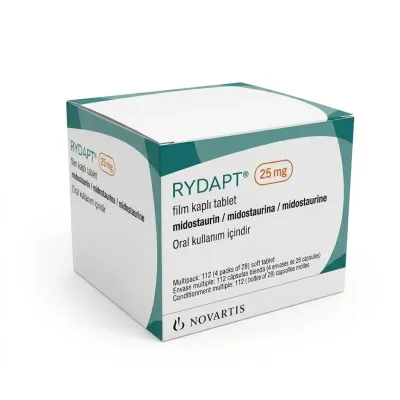
Midostaurin – Multi-Targeted FLT3 and KIT Kinase Inhibitor Therapy
Midostaurin is a systemic antineoplastic agent formulated as a multi-targeted protein kinase inhibitor (a targeted small-molecule, semi-synthetic derivative of staurosporine). The mechanism of action of midostaurin involves competitive inhibition of adenosine triphosphate (ATP) binding to the catalytic domains of numerous receptor and non-receptor tyrosine kinases. The drug exhibits a prominent affinity for mutant and wild-type forms of the FLT3 receptor (Fms-like tyrosine kinase 3), including internal tandem duplication (FLT3-ITD) types and tyrosine kinase domain (FLT3-TKD) mutations. Blockade of FLT3 halts constitutive intracellular signaling cascades, inducing cell cycle arrest and apoptosis within leukemic cell lines. Furthermore, midostaurin effectively suppresses the activity of KIT receptors (both wild-type and the mutant D816V isoform), stem cell factor receptors, vascular endothelial growth factor receptors VEGFR-1 and VEGFR-2, and various protein kinase C (PKC) isoforms, thereby preventing uncontrolled mast cell proliferation and angiogenesis.
The clinical uniqueness of midostaurin lies in its established ability to radically alter the prognosis of aggressive hematological malignancies that were historically deemed highly treatment-resistant. Combined with standard induction chemotherapy (daunorubicin and cytarabine), it significantly prolongs overall survival in patients presenting with newly diagnosed FLT3-mutation-positive acute myeloid leukemia (AML). The drug also serves as an indispensable first-line option for advanced systemic mastocytosis (ASM), mast cell leukemia, and systemic mastocytosis associated with an underlying hematological non-mast cell lineage disease (SM-AHN). Following oral administration, midostaurin demonstrates substantial absorption when co-administered with high-fat meals. It binds extensively and almost completely (~99.8%) to plasma proteins. It undergoes predominant hepatic biotransformation via the CYP3A4 isoenzyme to form two major active metabolites (CGP62221 and CGP52421), with the concentrations of the long-lived metabolite CGP52421 greatly exceeding those of the parent drug during steady-state dosing. The elimination half-life is approximately 20–21 hours for midostaurin and up to 36 days for the CGP52421 metabolite. Systemic clearance occurs mainly through the feces (95%) as metabolites.
The drug is administered orally. Initiating therapy mandates prior genetic confirmation of the FLT3 mutation status in patients with AML. Ongoing treatment requires strict, regular laboratory monitoring of complete blood counts, biochemical panels (including electrolytes, lipase, and liver function parameters), ECG tracking of the QT interval, and consistent respiratory monitoring due to risks of pulmonary toxicity.

Indications
Midostaurin is indicated for the systemic targeted therapy of adult patients presenting with the following malignant hematological disorders:
- Acute Myeloid Leukemia (AML): comprehensive management in combination with standard induction chemotherapy (daunorubicin and cytarabine) and consolidation chemotherapy (high-dose cytarabine) in patients with newly diagnosed FLT3-mutation-positive acute myeloid leukemia.
- Advanced Systemic Mastocytosis (ASM): monotherapy for patients with aggressive systemic mastocytosis presenting with extensive organ damage and multi-organ dysfunction.
- Systemic Mastocytosis with an Associated Hematological Disease: management of systemic mastocytosis accompanied by a secondary clonal hematological non-mast cell lineage disease (SM-AHN).
- Mast Cell Leukemia (MCL): therapy for the highly aggressive neoplastic presentation of mast cell leukemia.
Dosage and administration
The dosing regimen of midostaurin is customized based on the clinical diagnosis, concurrent chemotherapy protocols, and individual patient tolerability, requiring cyclic or continuous administration.
- Dose in Acute Myeloid Leukemia (AML): the recommended dose is 50 mg (two 25 mg capsules) taken orally twice daily (totaling 100 mg per day). During the induction and consolidation phases, the drug is administered from Day 8 through Day 21 of each 28-day chemotherapy cycle. For subsequent maintenance monotherapy, the drug is taken continuously and daily for up to 12 cycles.
- Dose in Advanced Systemic Mastocytosis and Mast Cell Leukemia: the recommended dose for continuous regimen is 100 mg taken orally twice daily (totaling 200 mg per day). Treatment is maintained continuously as long as clinical benefit is observed or until unacceptable toxicity develops.
- Administration Method: capsules must be swallowed whole with a glass of water and never chewed. The drug must be taken with food (ideally a meal of standard fat content) twice daily at approximately 12-hour intervals. This administration schedule significantly mitigates the severity of gastrointestinal side effects.
- Missed Dose and Vomiting: if a scheduled dose is missed, the patient should skip it and take the next dose at its regular time on the following day. If vomiting occurs after capsule ingestion, an additional dose must not be administered; the regular dosing schedule should be resumed.
- Dose Modifications for Toxicity: in the event of severe neutropenia, thrombocytopenia, QT interval prolongation exceeding 500 ms, or pulmonary toxicity, midostaurin therapy should be temporarily interrupted or down-titrated until clinical resolution occurs.