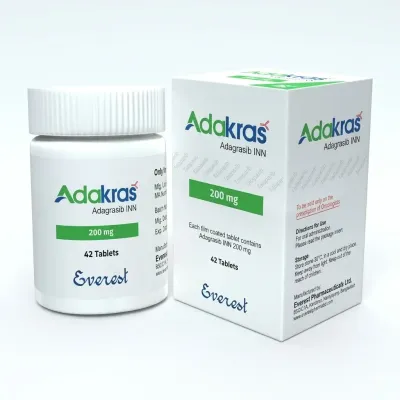
Adagrasib – Highly Selective KRAS G12C Inhibitor Targeted Therapy
Known as original brand(s)
Krazati
Adagrasib is an oral, highly selective, small-molecule inhibitor of the KRAS oncoprotein harboring a specific G12C somatic mutation, engineered for the targeted therapy of solid tumors. The KRAS G12C mutation is characterized by a glycine-to-cysteine substitution at codon 12, which locks the protein in a constitutively active, GTP-bound state, driving continuous cell proliferation through the downstream MAPK/ERK signaling pathway. The mechanism of action of adagrasib involves irreversible covalent binding to the specific Switch II pocket of the mutant KRAS G12C protein in its inactive, GDP-bound state. This stable binding blocks nucleotide exchange, effectively trapping the oncoprotein in an inactive conformation and completely disrupting downstream oncogenic signaling cascade, thereby inducing apoptosis and cell cycle arrest in tumor tissues. A distinct pharmacokinetic feature of adagrasib is its long half-life and its capability to sustain plasma concentrations above the target inhibition threshold across the entire dosing interval.
The clinical uniqueness of adagrasib lies in its high systemic exposure and its ability to penetrate the blood-brain barrier, enabling objective clinical responses in patients with metastatic central nervous system lesions arising from non-small cell lung cancer. The drug exhibits moderate oral bioavailability, which is not critically altered by food intake; however, co-administration with a high-fat meal may enhance gastrointestinal tolerability. Peak plasma exposure is achieved within 6 to 7 hours. Adagrasib distributes extensively into tissues and is primarily metabolized in the liver via the CYP3A4 isoenzyme, acting as both a substrate and a time-dependent inhibitor of this enzyme. The mean elimination half-life is approximately 23 hours. Systemic excretion of the active compound and its metabolites occurs predominantly through the intestines in the feces, with only a minor fraction cleared via the kidneys in the urine.
The drug is administered orally. Initiating therapy requires mandatory prior molecular-genetic confirmation of the KRAS G12C mutation in tumor tissue samples or circulating tumor DNA from a liquid biopsy. Ongoing treatment necessitates strict laboratory and instrumental monitoring, including regular assessment of hepatic and renal functions, as well as electrocardiography to monitor the QT interval.

Indications
Adagrasib is indicated as a systemic targeted monotherapy or combination treatment for adult patients presenting with the following malignant neoplasms:
- Non-Small Cell Lung Cancer (NSCLC): treatment of adult patients with locally advanced or metastatic KRAS G12C-mutated non-small cell lung cancer who have progressed on or after prior platinum-based chemotherapy and/or immune checkpoint inhibitor therapy.
- Colorectal Cancer (CRC): treatment of adult patients with precision-confirmed metastatic KRAS G12C-mutated colorectal cancer previously treated with intensive chemotherapy regimens (fluoropyrimidines, oxaliplatin, irinotecan), administered in combination with anti-EGFR monoclonal antibodies (cetuximab).
Dosage and administration
The dosing regimen of adagrasib is tailored individually, based on established protocols for mutant-driven tumors, and strictly mandates continuous daily administration.
- Standard Therapeutic Dose: the recommended starting dose is 600 mg taken orally twice daily (total daily dose of 1200 mg). The drug must be taken daily, at approximately the same time every 12 hours.
- Combination Treatment Schedule: in the treatment of colorectal cancer, adagrasib is administered at 600 mg twice daily continuously, alongside the concurrent administration of cetuximab according to its standard prescribing information.
- Administration Method: tablets are taken orally, with or without food, and must be swallowed whole with a sufficient amount of water. Tablets must not be broken, crushed, dissolved, or chewed during handling.
- Missed Dose: if a scheduled dose is delayed by more than 4 hours, that dose should be skipped. The patient must take the next scheduled dose at the regular time. Taking a double dose to make up for a missed one is strictly prohibited. If vomiting occurs after taking a tablet, an additional dose should not be administered.
- Dose Modification for Toxicity: if severe adverse reactions develop (such as hepatotoxicity, QTc interval prolongation, or severe diarrhea), therapy must be withheld. Upon resolution of symptoms, treatment is resumed with step-down dose reductions: first to 400 mg twice daily, then to 200 mg twice daily. If a patient cannot tolerate 200 mg twice daily, the drug must be permanently discontinued.