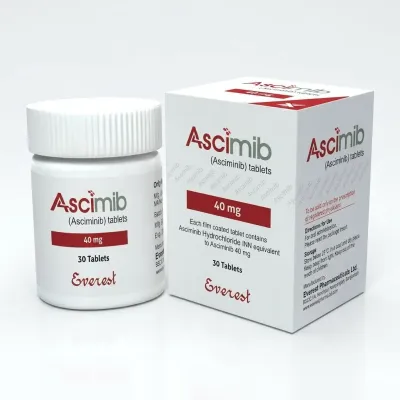
Asciminib – Specifically Targeted BCR-ABL1 Myristoyl Pocket Inhibitor
Known as original brand(s)
Scemblix
Asciminib is an oral, first-in-class tyrosine kinase inhibitor acting as a STAMP (Specifically Targeting the ABL Myristoyl Pocket) agent, engineered for the targeted therapy of chronic myeloid leukemia (CML). Unlike traditional first-, second-, and third-generation tyrosine kinase inhibitors (TKIs) (such as imatinib, nilotinib, dasatinib, bosutinib, and ponatinib) that compete with ATP for binding within the ATP-binding domain of the BCR-ABL1 oncoprotein, asciminib functions as an allosteric modulator. The drug binds with high specificity directly to the myristoyl pocket of the BCR-ABL1 protein. This binding event mimics the natural auto-inhibitory regulatory mechanism (the myristoyl "switch"), locking the kinase domain into a closed, rigid, and completely inactive conformation. This unique mechanism of action enables asciminib to maintain high therapeutic efficacy against most mutant variants of BCR-ABL1, including the pan-resistant T315I mutation, which typically drives resistance to classic TKIs.
The clinical uniqueness of asciminib lies in its exceptional selectivity: because the myristoyl pocket is uniquely characteristic of ABL-family kinases, the drug exerts virtually no off-target effects on other cellular kinases, providing an unprecedentedly favorable safety and tolerability profile during long-term administration. The drug displays good oral bioavailability when taken in a fasted state. Peak plasma exposure is achieved within 2 to 3 hours. Asciminib is extensively bound to plasma proteins and undergoes primary hepatic metabolism mediated via the CYP3A4 isoenzyme through oxidative pathways followed by glucuronidation. The elimination half-life is approximately 5.5 hours. Systemic clearance is achieved predominantly as unchanged parent drug and metabolites through the intestines in the feces, with only about 11% of the dose excreted via the kidneys in the urine.
The drug is administered orally. Mandatory baseline and ongoing molecular-genetic tracking of BCR-ABL1 transcript levels via quantitative PCR is required throughout therapy. Continuous laboratory monitoring of complete blood counts, serum lipase, and amylase levels is required to promptly detect myelosuppression and asymptomatic pancreatitis.

Indications
Asciminib is indicated as a systemic targeted therapy for adult patients with the following malignant hematological condition:
- Chronic Myeloid Leukemia (CML): treatment of adult patients with Philadelphia chromosome-positive (Ph+) CML in chronic phase (CP) previously treated with two or more tyrosine kinase inhibitors, and treatment of adult patients with Ph+ CML in CP harboring the T315I mutation.
Dosage and administration
The dosing regimen of asciminib depends on the genetic mutation profile of the malignant clone (the presence of the T315I mutation) and strictly mandates careful timing relative to food intake.
- Standard Dose for CML without the T315I Mutation: the recommended therapeutic dose is 40 mg taken orally twice daily (every 12 hours) or 80 mg taken orally once daily.
- Standard Dose for CML harboring the T315I Mutation: the recommended therapeutic dose is 200 mg taken orally twice daily (approximately every 12 hours).
- Schedule and Duration: the drug is structured for continuous daily administration. Therapy must be maintained long-term as long as an objective cytogenetic and molecular response is sustained or until unacceptable systemic toxicity occurs.
- Administration Method: tablets must be swallowed whole with water. It is strictly required that patients fast for at least 2 hours before taking the dose and for at least 1 hour after taking it, as food significantly reduces drug bioavailability. Tablets must not be broken, crushed, or chewed during handling.
- Missed Dose: for the twice-daily regimen, if a dose is missed by more than 4 hours (or for the once-daily regimen, by more than 8 hours), it should be skipped. The patient must take the next dose at the regular scheduled time. Taking a double dose is strictly prohibited.
- Dose Modification for Toxicity: if severe neutropenia, thrombocytopenia, or elevated lipase levels develop, therapy must be withheld until parameters return to baseline. Upon recovery, treatment is resumed with step-down reductions (e.g., from 40 mg twice daily down to 20 mg twice daily, or from 200 mg twice daily down to 160 mg twice daily).