
Avatrombopag – Thrombopoietin Receptor Agonist for Thrombocytopenia

Avatrombopag is an oral, highly selective, second-generation small-molecule thrombopoietin receptor (c-Mpl) agonist engineered for the pathogenic treatment of severe thrombocytopenia of various etiologies. The mechanism of action of avatrombopag involves specific binding to the transmembrane domain of thrombopoietin receptors on the surface of hematopoietic stem cells and megakaryocytes. The drug mimics the biological activity of endogenous thrombopoietin, initiating intracellular JAK/STAT and MAPK signaling cascades. This pathway activation stimulates the targeted proliferation and differentiation of megakaryocyte progenitor cells, accelerates their maturation, and enhances the shedding of functionally active platelets, leading to a dose-dependent increase in peripheral platelet counts. A critically important clinical feature of avatrombopag is that it binds to a distinct site on the receptor and does not compete with natural thrombopoietin, providing a synergistic therapeutic effect without inducing neutralizing autoantibodies.

The clinical uniqueness of avatrombopag lies in its capacity to rapidly and predictably expand platelet counts in patients with chronic liver diseases, enabling the safe execution of scheduled invasive diagnostic and surgical interventions without requiring prophylactic donor platelet transfusions. The drug exhibits high oral bioavailability, which is significantly enhanced when co-administered with a high-fat meal. Peak plasma exposure is achieved within 5 to 6 hours. Avatrombopag possesses a prolonged elimination half-life (approximately 19 hours) and undergoes oxidative hepatic clearance mediated primarily via CYP2C9 and CYP3A4 isoenzymes. Systemic excretion of the parent compound and its metabolites is achieved predominantly through the intestines in the feces, with only a minimal fraction cleared via the kidneys in the urine.

The drug is administered orally. Initiating therapy requires mandatory baseline determination of peripheral platelet levels via a complete blood count. Regular laboratory monitoring of the hemogram is essential throughout short-term preoperative courses or long-term regimens to prevent excessive thrombocytosis and minimize systemic thromboembolic liabilities.

Wikipedia page
Avatrombopag

Indications

Avatrombopag is indicated as a systemic targeted therapy for adult patients presenting with the following conditions associated with thrombocytopenia:

  • Thrombocytopenia in Chronic Liver Disease: treatment of severe thrombocytopenia in adult patients with chronic liver disease who are scheduled to undergo any planned invasive medical or surgical procedure.
  • Immune Thrombocytopenia (ITP): treatment of persistent or chronic primary immune thrombocytopenia in adult patients who exhibit resistance or an inadequate clinical response to prior first-line interventions (such as corticosteroids, immunoglobulins, or splenectomy).

Dosage and administration

The dosing regimen of avatrombopag is individually tailored based on the clinical indication and baseline platelet counts, and strictly requires administration with food.

  • Dosing for Scheduled Invasive Procedures: in chronic liver disease, dosing is stratified by baseline platelet count. For counts below 40 x 10⁹/L, the recommended dose is 60 mg (three tablets) orally once daily. For counts from 40 x 10⁹/L to under 50 x 10⁹/L, the dose is 40 mg (two tablets) orally once daily. Therapy begins 10 to 13 days prior to the procedure, continues for exactly 5 consecutive days, and the procedure should be performed 5 to 8 days after the final dose.
  • Dosing for Chronic ITP: the recommended initial dose is 20 mg (one tablet) orally once daily. Subsequent titration is performed (ranging from 20 mg once weekly up to a maximum of 40 mg daily) to achieve and maintain a stable target platelet count of at least 50 x 10⁹/L to reduce bleeding risks.
  • Administration Method: tablets must be swallowed whole at approximately the same time each day and must be taken with food (ideally a high-fat meal). Tablets must not be broken or crushed during handling.
  • Missed Dose: if a scheduled dose is missed, the patient should take it immediately with food as soon as it is remembered. However, if the time overlaps closely with the next scheduled dose, the missed dose should be skipped; a double dose must never be taken.
  • Dose Modification for Thrombocytosis: if platelet counts exceed the therapeutic target (above 400 x 10⁹/L) during ITP treatment, avatrombopag must be immediately withheld. Therapy may be resumed after counts fall below 150 x 10⁹/L, with a step-down dose reduction.

The use of avatrombopag is restricted by severe risks of acute thromboembolic complications, individual hypersensitivity, and specific safety guardrails, and is contraindicated in the following conditions:

  • Hypersensitivity: documented history of anaphylaxis, angioedema, or individual hypersensitivity to avatrombopag or any inactive formulation excipients.
  • Elevated Thromboembolic Susceptibility: extreme caution is warranted in patients with known prothrombotic risk factors (including protein C or S deficiency, Factor V Leiden mutation, or a history of thrombosis), as rapid platelet elevations are associated with portal vein thrombosis or deep vein thrombosis.
  • Pregnancy and Lactation: adequate clinical safety data in pregnant women are lacking, and preclinical models indicate a potential for reproductive toxicity. Use during pregnancy is not recommended. Breastfeeding is strictly contraindicated during treatment and for at least 2 weeks following the final dose.
  • Pediatric Population: the efficacy and safety profile of the drug in children and adolescents under the age of 18 have not been established; use within this age cohort is not indicated.

The side effects of avatrombopag are predominantly driven by systemic vascular changes, hyperactivation of the platelet lineage, and individual metabolic responses:

  • Thromboembolic Complications: the most clinically severe risk involves the development of portal vein thrombosis (particularly prominent in patients with liver cirrhosis), pulmonary embolism, myocardial infarction, and deep vein thrombosis of the lower extremities.
  • Nervous System: very frequently presents as pronounced headache (including migraine-like episodes), dizziness, paresthesia, and transient sleep disturbances (insomnia).
  • Gastrointestinal Tract: frequent occurrences of nausea, dyspepsia, vomiting, abdominal pain, flatulence, dry oral mucosa, and persistent constipation.
  • Respiratory System and General Symptoms: upper respiratory tract infections, exertional dyspnea, marked fatigue, asthenia, peripheral edema, and generalized musculoskeletal pain (arthralgia and myalgia).
  • Laboratory Parameters: mild to moderate elevations in liver transaminases (ALT, AST), hyperbilirubinemia, and transient fluctuations in plasma lipid profiles.

Frequently Asked Questions

Avatrombopag is an oral targeted therapy that functions as a small-molecule thrombopoietin (TPO) receptor agonist. It mimics the biological actions of endogenous thrombopoietin by selectively binding to the TPO receptors expressed on the surface of hematopoietic stem cells and megakaryocytes in the bone marrow. This interaction initiates intracellular signaling cascades that promote the proliferation, maturation, and differentiation of megakaryocytic progenitor cells, ultimately inducing a controlled increase in the production of functional platelets.
Avatrombopag is indicated for two primary clinical scenarios. First, it is used to treat severe thrombocytopenia in adult patients with chronic liver disease who are scheduled to undergo an invasive diagnostic or surgical procedure (to minimize bleeding risks). Second, it is indicated for the treatment of chronic immune thrombocytopenia (ITP) in adult patients who have demonstrated an insufficient therapeutic response to prior treatments, such as systemic corticosteroids or immunoglobulins.
Avatrombopag tablets must be administered orally once daily and strictly with food. Co-administration with a meal significantly enhances the drug's absorption and stabilizes its plasma concentration. Dosing relies on the clinical indication: for scheduled invasive procedures in patients with chronic liver disease, it is taken as a short 5-day consecutive course initiated exactly 10 to 13 days prior to the procedure date. The procedure itself should be performed 5 to 8 days after the final dose. In chronic ITP, it is used as a long-term maintenance therapy with doses adjusted dynamically based on ongoing lab results.
Because avatrombopag drives the accelerated production of platelets, excessive or rapid elevations in platelet counts significantly increase the risk of severe thromboembolic events. These include portal vein thrombosis (a critical consideration in patients with hepatic cirrhosis), deep vein thrombosis, and pulmonary embolism. Patients must seek immediate medical evaluation upon developing sudden lower extremity swelling or pain, acute dyspnea, chest pain, or severe abdominal pain. Platelet counts must be assessed at baseline and monitored routinely throughout therapy.
Aside from coagulation-related baseline risks, the most frequently reported adverse effects associated with avatrombopag include headache, increased fatigue (asthenia), peripheral edema, and gastrointestinal symptoms such as nausea and abdominal pain. Patients receiving long-term treatment for chronic immune thrombocytopenia also commonly report arthralgia (joint pain) and myalgia (muscle pain). While these manifestations are typically mild to moderate, they should be reviewed with the managing physician to implement appropriate supportive care.

List of medicines by active substance

-16%
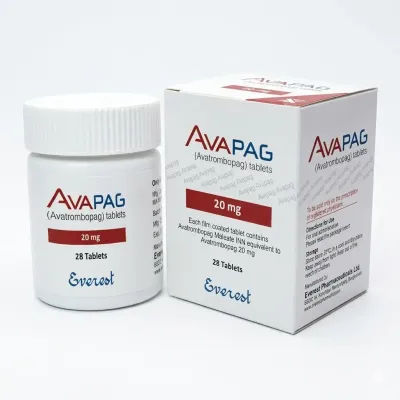
Avapag 20 mg Everest
View
Everest
20 mg 28 tablets
7066₴ 8391₴
✅ All products loaded (1)

Contact us

Choose a convenient way to contact

We work daily from 9:00 to 20:00