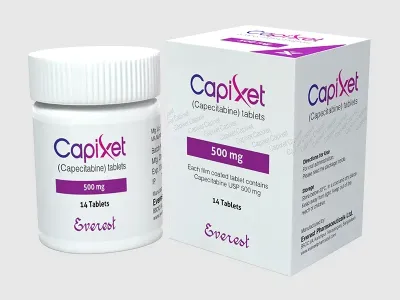
Capecitabine – Oral Fluoropyrimidine Carbamate Prodrug Chemotherapy
Capecitabine is an oral, highly selective fluoropyrimidine carbamate that functions as a first-choice systemic cytotoxic prodrug. It is engineered for the targeted chemotherapy of various solid tumors. Capecitabine itself possesses no intrinsic antineoplastic activity; its cytotoxic potential is activated exclusively within the body's tissues through a three-step sequential enzymatic cascade. Following oral administration, the drug is rapidly absorbed in the gastrointestinal tract and undergoes initial hepatic metabolism by carboxylesterase to form 5'-deoxy-5'-fluorocytidine (5'-DFCR). Next, cytidine deaminase, primarily localized in the liver and tumor tissues, converts 5'-DFCR into 5'-deoxy-5'-fluorouridine (5'-DFUR). The final step of metabolic activation is mediated by the enzyme thymidine phosphorylase (dThdPase), which converts 5'-DFUR into the active cytotoxic moiety, 5-fluorouracil (5-FU).
The clinical uniqueness of capecitabine lies in its tumor-selective activation: thymidine phosphorylase expression is significantly higher in malignant cells compared to healthy tissues, generating maximum local 5-FU concentrations directly at the tumor site while minimizing systemic exposure. The mechanism of action of the resulting 5-FU involves two distinct path modalities of tumor suppression. First, its metabolite (FdUMP) covalently binds to thymidylate synthase, completely blocking the synthesis of thymidine triphosphate required for DNA replication. Second, another metabolite (FUTP) erroneously incorporates into cellular RNA structure, disrupting RNA processing and protein synthesis, thereby inducing apoptosis. The drug displays high bioavailability, and its inactive metabolites are predominantly cleared via the kidneys in the urine.
The drug is administered orally. Prior to initiating therapy, screening for dihydropyrimidine dehydrogenase (DPD) expression status or activity is recommended, as inherited DPD deficiency carries a critical risk of severe, life-threatening systemic toxicity. Continuous monitoring of complete blood counts, renal function, and skin integrity is mandatory throughout treatment.

Indications
Capecitabine is indicated as systemic monotherapy or in combination regimens for adult patients with the following malignant solid tumors:
- Colorectal Cancer: adjuvant treatment of Duke's C (Stage III) colon cancer following surgical resection, and as first-line therapy for patients with metastatic colorectal carcinoma.
- Breast Cancer: in combination with docetaxel for locally advanced or metastatic breast cancer after failure of anthracycline-containing chemotherapy, or as monotherapy where taxane and anthracycline regimens have failed or are contraindicated.
- Gastric Cancer: first-line treatment of advanced or metastatic gastric and gastroesophageal junction adenocarcinoma in combination with platinum-based regimens.
Dosage and administration
The dosing regimen of capecitabine is individually calculated based on the patient's body surface area (BSA) and is structured around a cyclic administration schedule.
- Standard Dose: the recommended monotherapy dose is 1250 mg/m² of body surface area administered orally twice daily (morning and evening; total daily dose of 2500 mg/m²).
- Schedule and Duration: the drug is administered in conventional 3-week cycles consisting of 14 consecutive days of treatment followed by an obligatory 7-day rest period. The total number of cycles depends on the clinical protocol and tumor response.
- Administration Method: tablets must be swallowed whole with water within 30 minutes after the completion of a meal (breakfast and dinner). Tablets must not be broken, crushed, or split during handling.
- Missed Dose: if a scheduled dose is missed, it should not be taken late, and the dose must never be doubled at the next scheduled time. The patient should skip the missed dose and resume their regular schedule.
- Dose Modification for Toxicity: upon development of Grade 2, 3, or 4 toxicities (such as severe diarrhea or hand-foot syndrome), capecitabine must be withheld until the symptoms resolve to Grade 0–1. Subsequent cycles are resumed with step-down dose reductions of 25% or 50% from the baseline dose.