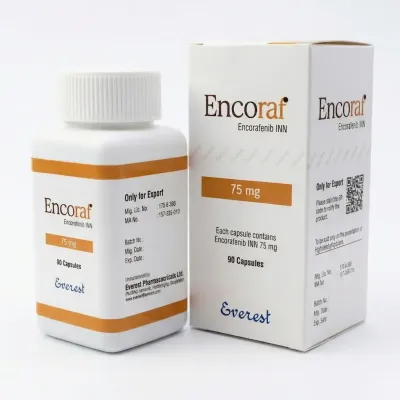
Encorafenib – Potent Selective BRAF Kinase Inhibitor Targeted Therapy
Known as original brand(s)
Braftovi
Encorafenib is an oral, highly selective, reversible small-molecule inhibitor of the BRAF serine-threonine kinases, engineered for the systemic targeted therapy of solid tumors harboring specific genetic mutations. The mechanism of action of encorafenib involves targeted binding to the ATP-binding domain of mutant forms of the BRAF kinase (including the most prevalent V600E mutation), resulting in potent suppression of its catalytic activity. This effectively characteristically interrupts the phosphorylation cascade along the mitogen-activated protein kinase (MAPK/ERK) signal transduction pathway, blocking downstream MEK and ERK targets. Consequently, cell proliferation is arrested, tumor angiogenesis is impaired, and programmed cell death (apoptosis) is induced. The core pharmacological feature of encorafenib is its uniquely prolonged target-binding half-life (exceeding 30 hours), which ensures sustained pathway inhibition even at low plasma trough concentrations, alongside a markedly lower incidence of paradoxical MAPK pathway activation in wild-type cells compared with first-generation BRAF inhibitors.
The clinical uniqueness of encorafenib lies in its superior therapeutic efficacy when combined with other targeted agents. In combination with a MEK inhibitor (binimetinib), it is utilized for the treatment of metastatic melanoma, significantly reducing overall toxicity and delaying the emergence of resistance. Combined with an anti-EGFR monoclonal antibody (cetuximab), encorafenib has established a standard of care for heavily pretreated BRAF V600E-mutant metastatic colorectal cancer, effectively overcoming the specific feedback reactivation mechanism mediated by the EGFR receptor. The drug exhibits good oral bioavailability, which is not clinically altered by food intake. Peak plasma exposure is achieved within a median of 1.5 to 2 hours post-dose. It is 86% bound to human plasma proteins. Encorafenib undergoes extensive hepatic metabolism primarily mediated by the CYP3A4 isoenzyme, with minor contributions from CYP2C19 and CYP2D6, forming active metabolites. The mean elimination half-life ranges from approximately 3.5 to 6 hours. Systemic clearance occurs predominantly through the intestines in the feces (62%), with a smaller fraction cleared via the kidneys in the urine (47%).
The drug is administered orally. Initiating therapy mandates prior molecular-genetic confirmation of the presence of a BRAF V600E mutation. Ongoing treatment requires regular dermatological assessments to detect new cutaneous malignancies, cardiac function monitoring (ejection fraction), ophthalmologic examinations, and routine hepatic and renal panels.

Indications
Encorafenib is indicated for the systemic targeted therapy of adult patients presenting with the following malignant neoplasms:
- Melanoma: treatment of adult patients with unresectable or metastatic melanoma harboring a BRAF V600E or V600K mutation, administered in combination with binimetinib.
- Colorectal Cancer (CRC): treatment of adult patients with metastatic colorectal cancer harboring a BRAF V600E mutation, who have received prior systemic therapy, administered in combination with cetuximab.
Dosage and administration
The dosing regimen of encorafenib depends on the specific clinical indication and mandates continuous daily administration, with modifications based on individual toxicity profiles.
- Dose in Melanoma: the recommended starting dose of encorafenib is 450 mg (six 75 mg capsules) taken orally once daily, administered in combination with binimetinib (45 mg twice daily).
- Dose in Colorectal Cancer: the recommended therapeutic dose of encorafenib is 300 mg (four 75 mg capsules) taken orally once daily, administered in combination with cetuximab.
- Administration Method: capsules are taken orally, at approximately the same time each day, with or without food. Capsules must be swallowed whole with a sufficient volume of water. Opening, breaking, chewing, or dissolving the capsules during handling is strictly prohibited.
- Missed Dose: if a scheduled dose is delayed by less than 12 hours, the patient must take the dose immediately. If the delay exceeds 12 hours, that dose must be skipped entirely, and the patient takes the next capsule at the regularly scheduled time. Taking a double dose to compensate for a missed one is strictly prohibited. If vomiting occurs after taking a dose, a repeat capsule must not be administered on that day.
- Dose Modification for Toxicity: if severe adverse reactions develop (such as uveitis, severe hepatotoxicity, or QTc interval prolongation), therapy must be temporarily withheld. Upon clinical resolution of symptoms, treatment is resumed at a reduced dose. For melanoma: step down from 450 mg to 300 mg, then to 200 mg once daily. For colorectal cancer: step down from 300 mg to 200 mg, then to 150 mg once daily. If a patient cannot tolerate the minimum dose, the drug must be permanently discontinued. If binimetinib is permanently discontinued during melanoma treatment, the encorafenib dose must be reduced to a maximum of 300 mg once daily.