
Etoposide – Cancer & Lymphoma Treatment

Etoposide is a semi-synthetic antineoplastic agent derived from podophyllotoxin. The drug belongs to the group of topoisomerase II inhibitors and is a phase-specific cytostatic that acts primarily in the S and G2 phases of the cell cycle. Etoposide is widely used in oncology due to its ability to effectively induce the death of rapidly dividing malignant cells.

The mechanism of action of etoposide involves forming a stable complex with the topoisomerase II enzyme and the DNA molecule. This prevents the re-ligation of breaks in the DNA double helix that occur during replication. The accumulation of such unrepairable damage blocks cell division and triggers programmed cell death (apoptosis). The drug is effective against a broad spectrum of solid tumors and hematologic malignancies.

Etoposide is available in formulations for intravenous administration and oral intake. It has a high capacity to penetrate various body tissues, although it crosses the blood-brain barrier in a limited volume. The drug is metabolized in the liver and excreted primarily by the kidneys.

Wikipedia page
Etoposide

Indications

Etoposide is a key component of many chemotherapy protocols and is prescribed for the following conditions:

  • Germ Cell Tumors: testicular and ovarian cancer (often in combination with cisplatin and bleomycin).
  • Lung Cancer: small cell lung cancer (SCLC) as first-line therapy.
  • Hematologic Malignancies: acute myeloid leukemia, Hodgkin's lymphoma, and non-Hodgkin lymphomas.
  • Pediatric Tumors: neuroblastoma, Ewing's sarcoma, and Wilms' tumor (as part of complex regimens).
  • Other Solid Tumors: gastric cancer, breast cancer (in specific regimens when resistant to other therapy).

Dosage and administration

The dosing regimen of etoposide is established individually based on the diagnosis, the patient's body surface area (BSA), and renal function.

  • Intravenous Administration: the standard dose is 50–120 mg/m² daily for 3–5 days every 3–4 weeks. The infusion must be administered slowly (at least 30–60 minutes).
  • Oral Intake: the oral dose is typically twice the intravenous dose (due to approximately 50% bioavailability) and ranges from 100–200 mg/m² daily.
  • Administration Specifics: rapid intravenous injection may lead to a sudden drop in blood pressure (hypotension).
  • Dose Adjustment: required in cases of decreased creatinine clearance or significant liver function impairment.
  • Monitoring: a complete blood count (especially leukocyte and platelet levels) must be monitored before each cycle.
The use of etoposide is restricted in the presence of the following clinical contraindications:

  • Myelosuppression: severe leukopenia (less than 2000/µL) or thrombocytopenia (less than 75000/µL) before the start of treatment.
  • Severe Infections: acute infectious diseases in the active phase due to the risk of sepsis.
  • Pregnancy and Lactation: the drug has teratogenic effects; breastfeeding should be discontinued during therapy.
  • Hypersensitivity: allergic reactions to etoposide or components of the solvent (e.g., polysorbate 80).
  • Severe Hepatic Impairment: in cases of significant impairment of drug metabolism.

Etoposide has a characteristic toxicity profile requiring supportive therapy:

  • Hematologic Reactions: leukopenia (nadir at 7–14 days), anemia, and thrombocytopenia.
  • Gastrointestinal Tract: nausea and vomiting (usually moderate), diarrhea, stomatitis, and loss of appetite.
  • Dermatologic Reactions: reversible alopecia (hair loss is observed in the majority of patients).
  • Allergic Reactions: chills, fever, bronchospasm, and hypotension during infusion.
  • Secondary Processes: rarely, a risk of developing secondary leukemia with long-term use at high cumulative doses.

Frequently Asked Questions

Etoposide is a cytotoxic agent that inhibits the enzyme topoisomerase II. This enzyme is essential for repairing DNA strand breaks during cell division. By blocking it, etoposide causes irreversible DNA damage, preventing cancer cells from proliferating and leading to their death.
Etoposide has a broad spectrum of activity. It is frequently prescribed for small cell lung cancer, germ cell testicular and ovarian tumors, as well as acute leukemias and lymphomas. In most cases, it is used in combination with other agents (such as cisplatin) to enhance the therapeutic effect.
The substance is available as oral capsules and as a concentrate for solution for infusion. Capsules should be taken on an empty stomach or with a light meal and swallowed whole. If the intravenous form is used, administration must be slow (over 30–60 minutes), as rapid infusion can cause a sudden drop in blood pressure.
The primary side effect is myelosuppression—a decrease in the production of white blood cells (neutrophils) and platelets. The lowest blood counts (nadir) typically occur 7 to 14 days after starting the cycle. Regular blood monitoring is essential to prevent severe infections and bleeding risks.
Reversible alopecia (hair loss) is very common, occurring in up to 66% of cases. Etoposide can also cause inflammation of the oral mucosa (stomatitis). Patients are advised to maintain rigorous oral hygiene and use soft toothbrushes to minimize discomfort during treatment.

List of medicines by active substance Etoposide

-25%
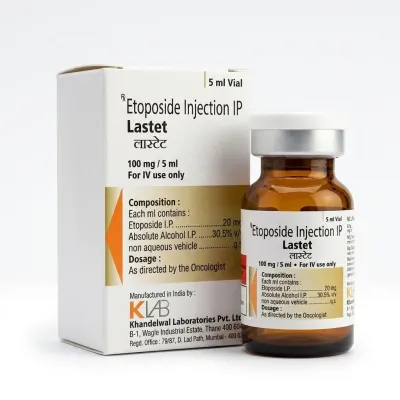
Lastet 100 100 mg / 5 ml Khandelwal
View
Khandelwal
100 mg / 5 ml 1 vial
659₴ 879₴
-20%
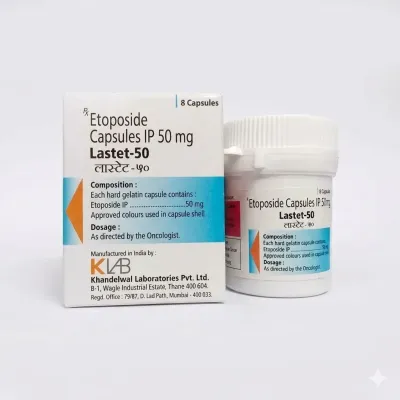
Lastet 50 50 mg Khandelwal
View
Khandelwal
50 mg 8 capsules
879₴ 1099₴
✅ All products loaded (2)

Contact us

Choose a convenient way to contact

We work daily from 9:00 to 20:00