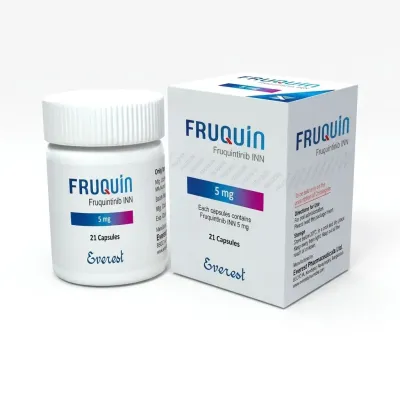
Fruquintinib – Highly Selective Oral VEGFR-1/2/3 Tyrosine Kinase Inhibitor
Known as original brand(s)
Fruzaqla
Fruquintinib is an oral, highly selective, and potent small-molecule inhibitor of vascular endothelial growth factor receptors (VEGFR) 1, 2, and 3, engineered for the systemic targeted therapy of solid tumors. The mechanism of action of fruquintinib involves blocking the autophosphorylation of kinase domains within VEGFR-1, -2, and -3 on the surface of endothelial cells, resulting in powerful suppression of the downstream VEGF signaling pathway. This disrupts endothelial cell proliferation, migration, and survival, critically halts neoangiogenesis (the formation of new blood vessels within tumor tissue), lowers intratumoral interstitial fluid pressure, and effectively stops the further metastatic dissemination and expansion of the malignant neoplasm. The core pharmacological feature of fruquintinib is its unprecedentedly high selectivity toward VEGFR kinases with minimal inhibition of other off-target kinases, which ensures a sustained therapeutic effect while minimizing risks of cross-reactive systemic toxicity.
The clinical uniqueness of fruquintinib lies in its ability to significantly extend overall survival and progression-free survival in heavily pretreated patients with metastatic colorectal cancer who have exhausted standard systemic regimens. The drug demonstrates high oral bioavailability that is not critically affected by food intake. Peak plasma exposure is achieved within a median of 2 to 4 hours post-dose. Fruquintinib is extensively bound to human plasma proteins (approximately 95%) and is primarily metabolized in the liver via the CYP3A4 isoenzyme through oxidative pathways. The mean elimination half-life is approximately 42 hours, providing stable systemic exposure. Systemic clearance of metabolites and the unchanged parent drug occurs at comparable rates via the kidneys in the urine and through the intestines in the feces.
The drug is administered orally. Prior to initiating therapy and regularly throughout its course, careful monitoring of blood pressure, hepatic function, urinary protein levels, and clinical signs of hemorrhagic complications or surgical wound healing performance is required.

Indications
Fruquintinib is indicated as a systemic targeted monotherapy for adult patients presenting with the following malignant neoplasm:
- Colorectal Cancer (CRC): treatment of adult patients with metastatic colorectal cancer who have been previously treated with standard fluoropyrimidine-, oxaliplatin-, and irinotecan-based chemotherapy regimens, as well as anti-VEGF biological therapies, and, if RAS wild-type, anti-EGFR therapies, or who have medical contraindications to these agents.
Dosage and administration
The dosing regimen of fruquintinib strictly requires a cyclic alternation of treatment periods and rest phases, alongside individual assessment of treatment tolerability.
- Standard Therapeutic Dose: the recommended starting therapeutic dose is 5 mg taken orally once daily.
- Cyclic Schedule: the drug is administered via an intermittent regimen: 3 weeks of daily dosing (21 days), followed by a 1-week rest period (7 days off treatment). A complete treatment cycle spans 28 days. Prescribed cycles are repeated continuously until disease progression or unacceptable systemic toxicity manifests.
- Administration Method: capsules are taken orally, at approximately the same time each day, with or without food. Capsules must be swallowed whole with a glass of water. Opening, breaking, or chewing the capsules during handling is strictly prohibited.
- Missed Dose: if a scheduled dose is delayed by less than 12 hours, the patient must take the missed capsule immediately and resume the regular schedule. If the delay exceeds 12 hours, that dose must be skipped entirely. Taking a double dose on the following day is strictly prohibited. If vomiting occurs after taking a dose, a repeat capsule must not be administered on that day.
- Dose Modification for Toxicity: if severe hypertension, prominent palmar-plantar erythrodysesthesia syndrome, or heavy proteinuria occurs, therapy must be temporarily withheld. Upon clinical resolution of symptoms, treatment is resumed with step-down dose reductions: first to 4 mg once daily, then to 3 mg once daily. If a patient cannot tolerate 3 mg once daily, the drug must be permanently discontinued.