
Paclitaxel – Targeted Therapy

Paclitaxel is a naturally derived antitumor agent belonging to the taxane group. Originally isolated from the bark of the Pacific yew tree, this substance represented a breakthrough in the therapy of solid tumors due to its unique mechanism of action on the cellular framework.

The mechanism of action of paclitaxel involves stimulating the assembly of microtubules from tubulin dimers and stabilizing them by inhibiting depolymerization. This disrupts the normal process of dynamic microtubule reorganization, which is essential for cell division (mitosis). As a result, the cell is blocked in the G2 and M phases, making the completion of division impossible and leading to the initiation of apoptosis. Paclitaxel also inhibits angiogenesis (the formation of new blood vessels in the tumor).

The drug is administered by intravenous infusion. Due to its poor water solubility, classical formulations contain castor oil (Cremophor EL), which requires mandatory pre-treatment (premedication) of the patient to prevent allergic reactions.

Wikipedia page
Paclitaxel

Indications

Paclitaxel is widely used for the treatment of various forms of malignant neoplasms:

  • Ovarian Cancer: first-line therapy (in combination with platinum agents) and second-line therapy for metastatic disease.
  • Breast Cancer: adjuvant treatment for node-positive disease, as well as the treatment of metastatic forms.
  • Non-Small Cell Lung Cancer (NSCLC): in combination with cisplatin for patients who are not candidates for surgery or radiation therapy.
  • Kaposi's Sarcoma: AIDS-related, in cases where previous therapy with liposomal anthracyclines has failed.

Dosage and administration

The dose of paclitaxel is selected individually and depends on the treatment regimen (3-week or weekly cycles).

  • Standard Dosage: typically ranges from 135 mg/m² to 175 mg/m² of the patient's body surface area.
  • Administration Method: intravenous infusion over 3 or 24 hours. The use of special non-PVC administration sets is required.
  • Premedication: mandatory administration of glucocorticoids, antihistamines, and H2-receptor blockers 30–60 minutes before the infusion.
  • Lab Monitoring: administration is possible only if the neutrophil count is ≥ 1,500/mm³ and the platelet count is ≥ 100,000/mm³.
  • Cycling: most commonly administered once every 3 weeks, although weekly protocols may be better tolerated.
The use of paclitaxel is contraindicated in the following conditions:

  • Hypersensitivity: allergy to paclitaxel or castor oil (Cremophor EL).
  • Low Blood Counts: baseline neutrophil count less than 1,500/mm³.
  • Infections: severe concurrent infectious diseases.
  • Hepatic Impairment: severe impairment of liver function.
  • Pregnancy and Lactation: the drug is toxic to the fetus; breastfeeding must be discontinued during therapy.
  • Pediatric Use: safety and efficacy in children have not been established.

Paclitaxel has a characteristic spectrum of side effects that require medical supervision:

  • Allergic Reactions: flushing, skin rash, and in rare cases, bronchospasm and anaphylaxis.
  • Hematologic: neutropenia (the main dose-limiting factor), anemia, and thrombocytopenia.
  • Nervous System: peripheral neuropathy (numbness and tingling in the extremities).
  • Musculoskeletal System: arthralgia (joint pain) and myalgia (muscle pain).
  • Other: alopecia (complete hair loss), nausea, diarrhea, and nail changes.

Frequently Asked Questions

Paclitaxel is a natural antineoplastic agent originally isolated from the bark of the Pacific yew tree. It belongs to the taxane class of drugs. Unlike many other agents that destroy cellular microtubules, paclitaxel "freezes" them in a stable state. This interferes with the cancer cell's ability to divide and replicate, ultimately leading to cell death.
Paclitaxel has a very broad spectrum of activity. It is most frequently used to treat ovarian cancer, breast cancer, non-small cell lung cancer, and Kaposi's sarcoma. It is utilized both as a first-line therapy and in the treatment of advanced stages of the disease.
Paclitaxel can cause severe hypersensitivity reactions (allergic reactions). This is due to both the active substance itself and the solvent used in certain formulations. To minimize this risk, all patients must receive premedication with corticosteroids, antihistamines, and H2-receptor antagonists before the infusion begins.
A characteristic side effect of paclitaxel is peripheral neuropathy. It often presents as tingling, a "pins and needles" sensation, or numbness in the hands and feet. Patients are advised to inform their doctor about these symptoms, as increasing severity may require dose adjustments or changes to the treatment schedule.
The substance causes temporary bone marrow suppression, leading to a decrease in white blood cell counts (increasing infection risk). Paclitaxel is also known to cause significant alopecia (hair loss), which typically begins 14 to 21 days after the first dose. It is important to note that hair growth completely resumes after treatment is concluded.

List of medicines by active substance

-15%
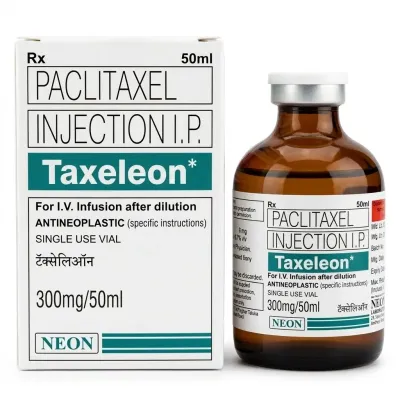
Taxeleon 300 300 mg / 50 ml Neon
View
Neon
300 mg / 50 ml 1 vial
2435₴ 2878₴
-13%
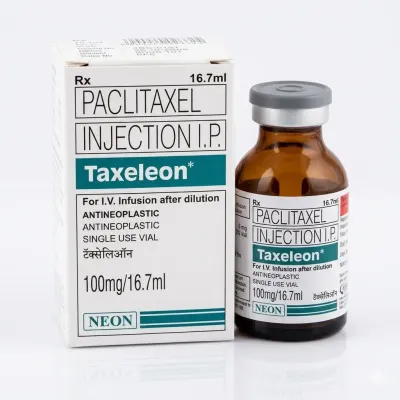
Taxeleon 100 100 mg / 16.67 ml Neon
View
Neon
100 mg / 16.67 ml 1 vial
1195₴ 1372₴
✅ All products loaded (2)

Contact us

Choose a convenient way to contact

We work daily from 9:00 to 20:00