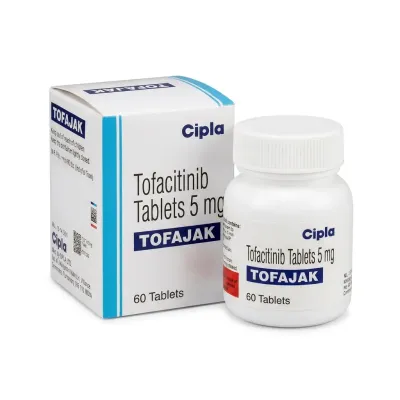
Tofacitinib – JAK Inhibitor Therapy

Tofacitinib is an innovative oral medication that functions as a selective inhibitor of the Janus kinase (JAK) family. Unlike traditional biological agents that target extracellular cytokines, tofacitinib works inside the cell by blocking signaling pathways responsible for the onset and maintenance of the inflammatory process in autoimmune diseases.

The drug's mechanism of action is based on the specific inhibition of JAK1, JAK2, and, most notably, JAK3 enzymes. These enzymes play a critical role in transmitting signals from cytokine receptors (such as interleukins IL-2, IL-4, IL-7, IL-9, IL-15, and IL-21) to the cell nucleus via Signal Transducer and Activator of Transcription (STAT) proteins. By blocking this JAK-STAT pathway, tofacitinib effectively reduces the production of inflammatory mediators and suppresses abnormal immune system activity. This leads to a significant reduction in damage to joints, the intestinal mucosa, and skin tissues, depending on the specific diagnosis. The drug features a rapid onset of action and high systemic bioavailability after oral administration.

Tofacitinib can be used as monotherapy or in combination with methotrexate or other non-biological disease-modifying antirheumatic drugs (DMARDs).

Wikipedia page
Tofacitinib

Indications

Tofacitinib is indicated for the treatment of adult patients with the following chronic immune-mediated diseases:

  • Rheumatoid Arthritis: treatment of moderate to severe active rheumatoid arthritis in patients who have had an inadequate response to one or more DMARDs.
  • Psoriatic Arthritis: therapy for active psoriatic arthritis (often in combination with non-biological agents).
  • Ulcerative Colitis: induction and maintenance therapy for adult patients with moderate to severe active ulcerative colitis when standard treatment has failed.
  • Ankylosing Spondylitis: treatment of adult patients with active ankylosing spondylitis (Bechterew's disease) who have had an inadequate response to TNF inhibitors.
  • Juvenile Idiopathic Arthritis: treatment of active polyarticular juvenile idiopathic arthritis in pediatric patients aged 2 years and older.

Dosage and administration

The dosing schedule for tofacitinib depends on the specific disease and the drug formulation (immediate-release or extended-release).

  • Standard Dose (5 mg tablets): typically prescribed as 5 mg twice daily (morning and evening).
  • Extended-Release (11 mg tablets): taken once daily at an 11 mg dose, which is equivalent to the 5 mg twice-daily regimen.
  • Ulcerative Colitis: the induction dose may be 10 mg twice daily for the first 8–16 weeks, followed by a maintenance dose of 5 mg twice daily.
  • Administration: the drug is taken orally with or without food. Tablets must be swallowed whole.
  • Dose Adjustment: reduction to 5 mg once daily is necessary for patients with severe renal impairment, moderate hepatic impairment, or those taking potent CYP3A4 inhibitors.


The use of tofacitinib is contraindicated or requires extreme caution in the following situations:

  • Infections: presence of serious active infections, including tuberculosis, sepsis, or localized opportunistic infections.
  • Organ Impairment: severe hepatic impairment (Child-Pugh Class C) or decompensated renal disease.
  • Blood Disorders: significant lymphopenia (less than 0.5 x 10⁹/L), neutropenia (less than 1.0 x 10⁹/L), or low hemoglobin levels (less than 80 g/L).
  • Pregnancy and Lactation: the drug is strictly contraindicated for pregnant women and nursing mothers due to risks to the infant.
  • Hypersensitivity: known allergy to tofacitinib or any of the inactive ingredients.
  • Thrombosis Risk: the drug should be used with caution in patients with risk factors for pulmonary embolism.

Tofacitinib therapy may cause systemic adverse reactions that require medical supervision:

  • Infectious Diseases: upper respiratory tract infections, nasopharyngitis, and Herpes zoster (shingles) are most common.
  • Laboratory Parameters: increased blood cholesterol levels (hypercholesterolemia), elevated creatine phosphokinase, and increased liver transaminases.
  • Gastrointestinal: abdominal pain, diarrhea, nausea, gastritis, and very rarely, GI perforation (especially in patients with diverticulitis).
  • Nervous System: headache, insomnia, and dizziness.
  • Cardiovascular System: possible increase in blood pressure (hypertension).
  • General Symptoms: peripheral edema (swelling of the legs), increased fatigue, and skin rash.

Frequently Asked Questions

Tofacitinib is a modern oral medication belonging to the class of Janus kinase (JAK1, JAK2, JAK3) inhibitors. It works inside the cell by blocking signaling pathways that transmit instructions to produce cytokines—proteins that trigger inflammation. By suppressing these signals, tofacitinib helps reduce pain, swelling, and the destruction of joints or mucosal linings.
The primary indications include rheumatoid arthritis, psoriatic arthritis, ankylosing spondylitis, and moderate to severe ulcerative colitis. Tofacitinib is often prescribed for patients who have not responded adequately to standard therapies or biological agents.
Because tofacitinib modulates the immune system, it can lead to the reactivation of latent infections, including tuberculosis and hepatitis B. Before starting treatment, physicians perform a mandatory screening to ensure the therapy is safe and will not trigger serious complications.
In addition to monitoring white blood cell counts and hemoglobin, it is important to check cholesterol levels (lipid profile) while taking tofacitinib. The drug can cause an increase in LDL ("bad" cholesterol). Monitoring is typically performed 4–8 weeks after starting treatment to allow for dietary adjustments or concurrent therapy if necessary.
Yes, studies indicate that JAK inhibitors can increase the risk of developing shingles (herpes zoster). Physicians may discuss the option of shingles vaccination prior to starting therapy. If a characteristic painful, blistering rash appears, the patient should stop the medication immediately and contact their doctor.

List of medicines by active substance

-9%
Tofajak Ointment 2% Cipla
View
Cipla
2% 1 tube
2245₴ 2469₴
-21%
Tofaxen 5 mg Everest
View
Everest
5 mg 60 tablets
9876₴ 12569₴
-21%
Tofajak 5 mg Cipla
View
Cipla
5 mg 60 tablets
2469₴ 3142₴
✅ All products loaded (3)

Contact us

Choose a convenient way to contact

We work daily from 9:00 to 20:00